Monday, October 29, 2007

My Tour of Banija 2007

Banija is a small region in Croatia. Although small in size (about 25 miles in diameter), the region has a very rich and complex history. Besides the Croats and Serbs living in Banija today, the Celts, Romans, Ottomans, Austrians, Hungarians, French, and Germans will be mentioned here because of the impact their presence in the past has had on the region’s present. I was born in 1961 in village Mali Gradac, which is located near the geographical center of the region. Like the rest of the region, the village also has had an interesting and troublesome history. Some of that history is unfortunately related to the two most recent wars that swept through Banija: World War II and the war of 1990s that coincided with disintegration of Yugoslavia.

I do not know exactly when the idea of riding around Banija entered my mind, but once it did I knew that sooner or later I will have to do it. But, why to ride around Banija? Would that be, as Forrest Gump could put it, “for no particular reason”? Was the ride meant to be some sort of tribute to the area that I call home, or just a self-serving act of riding bicycle in Europe and boasting about it afterward? Or, could it be that the ride was going to be an innate way of protesting silently the exile of thousands of fellow Banijans who were expelled from their homes first in 1991 and then in 1995 and who are mostly discouraged from returning to their homes even today, twelve years after the conflict? Regardless what the reason(s) could have been, I certainly do not know the true answer to the question.

Shipping the bicycle

These days shipping a bicycle to another continent seems to be a no brainer; you just pack the bike and ship it. That simple! However, once you pause for a moment and think about the task many issues come to your mind. I was lucky that I got timely in touch with Rita Zeidner, the journalist and the representative of the Potomac Pedalers Touring Club, who not only provided me with a hard shell transporting bike case, but also with a link to a program designed to assist bicyclists in planning their routes. The tool, which is available at http://veloroutes.org, allowed me to map the route, measure the distance and grades of the slopes on the route, as well as to obtain the cumulative elevation gain. Once created the route is viewable as a map, hybrid, and satellite image. It also could be opened in google earth. Although the tool came relatively late in my planning, I found it very useful.

The outline of my route is available at: http://veloroutes.org/bikemaps/?route=4517.

One of the questions that were constantly on my mind before boarding the flight was whether and how much my airliner will charge me extra for flying the bicycle in a box.

Eventually it turned out that I did not have to worry about it because the United and Croatia Airlines treated the box as a regular piece of luggage for which they assessed no additional fee.

Preparation for the ride


I got up early in the morning on the day of the ride. The purpose was not only to start the ride early in the day, but also to eat properly ahead of the ride and allow for at least one hour of rest before commencing the ride. Eating before the ride was very important because of my expectation that the ride will last between 7 and 8 hours at expense of about 1000 kcal per hour. Therefore, it was very important to eat at least 1000 to 1500 kcal before the ride. I knew I could not eat more than that without overloading my digestive tract. I also knew that I could consume additional 2000 to 3000 kcal from energy bars I brought along. The difference in energy need not covered by these intakes would have to come on a loan from my body tissues.
The Ride

Braving the morning chill and rainy clouds, I left home at exactly 8:00 AM local time. After couple of miles mostly downhill riding, I entered the village of Klasnic. There, near an 8% climb is where in 1942 one of the most elite Yugoslav partisan units in World War II, the 7th Banija Division, was formed. The 4100-fighter strong Division left Banija in January 1943 and after a string of heavy fighting with the Germans and their collaborators, suffered heavy casualties so that only 550 of them returned in Banija later in the year. For its sacrifice and heroism the Division was awarded by the attribute “Shock”, so that it ended the war as the 7th Banija Shock Division. In 1999 I was well – “shocked” by finding a picture of the Division featured at the cover of Time-Life World War II publication titled “Partisans and Guerillas” by Ronald H. Bailey.

Couple of miles past Klasnic the steepest climb on the entire route, the Vratnik hill and its switchbacks waited for me. The sign at the top of the hill was showing 467 m above the sea level, suggesting that in approximately two miles I climbed over 300 meters. Mirroring the climb on the other side of the hill was a steep downhill, which lead me into the village of Donji Zirovac. There, I easily identified the church and an adjacent building in which in January 1943 my father, a 12-year-old at the time, survived German bombing. Little over half century later, in 1995, when Croatia was retaking the area from the rebelling Serbs, the Muslim forces from the neighboring Bosnia crossed the border, entered the village at the same spot cutting off the column of the fleeing Serb civilians, and soon withdrew, but not before allegedly massacring about 300 civilians. The only people I could see in the village at the morning of the ride were in their 70s and 80s. Once prosperous village appeared very empty and quite, just like the rest of Banija villages I did see later that day. Lots of brownish fields surrounding the village suggested that they have not been worked on for at least some time. The question that was teasing my mind before, during, and after the ride, was “who really benefits from these empty areas?” “Is Croatia really a better place now that large swats of its territory are empty?” It is worth of noting that only about 15 years before the exodus of 1995, this very same road witnessed an effort of the world’s bicyclist elite to win the prestigious Tour of Yugoslavia. One stage of the Tour was ridden on this very same road.

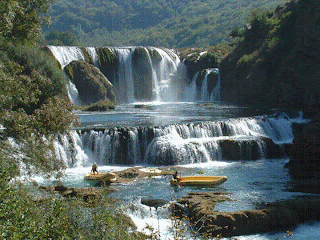
Another couple of miles later, I passed the town of Dvor, crossed the river Una, and entered the Bosnian town of Novi. The river Una is of an exceptionally beauty. It was probably a combination of its unique shade of the green and white water waterfalls that impressed the Romans so much to give the river name Una (Una means something like “the only one”, or “one of kind”). The river today separates Croatia and Bosnia and Herzegovina. In the past, the river was separating major world powers. For long time the river separated the Ottoman Empire from the Austrian Empire (later becoming Austro-Hungarian Empire), and then between 1809 and 1813, it separated the Ottoman Empire from Austrian and French Empires. Until well into the second half of the 19th century, the Banija region was incorporated in a defense line called Military Frontier that was organized as a defense line aimed at preventing the Turks to penetrate deeper in Europe. The river was the frontier for both sides.

I crossed the river to ride in Bosnia because of the better road on the Bosnian side. Although originally I intended to stay on the Bosnian side until the town of Bosanska Dubica, the closure of the border crossing in Dubica made me modify my plan and re-enter Croatia in the town of Hrvatska Kostajnica.

Hrvatska Kostajnica experienced very heavy fighting in 1991 when animosities between the Croatian forces and Croatian Serb population lead to war. The town suffered enormously and many buildings are still showing the signs of devastation. Many were damaged beyond repair and are standing as silent reminders of those lead-laden times. The question they seemed to be asking silently is: “why”? In sharp contrast with damaged and abandoned buildings, stands freshly painted church. During my visit to Croatia I concluded that the majority of freshly renovated facades outside of Zagreb, the Croatia’s capital, are either Catholic Church buildings or buildings carrying billboards. The Kostajnica region was home to two Borojevics: Svetozar who was the only Slav field marshal in the Austro-Hungarian military, and Slavko who became a world renowned plant geneticist following his heroic fighting of the Nazis as a partisan for four years.

The next town on my route was the town of Hrvatska Dubica. The only thing I would mention about this small town was the road sign pointing toward Jasenovac, the place in which one of the worst World War II concentration camps was located. The camp, which actually consisted of several smaller camps gravitating to Jasenovac, was fully operated by the Ustashi. An exact, or even approximate, number of people who were killed in Jasenovac has not been fully established. Current estimates, which put the number to about 100,000, are not universally accepted. In truth, it is not only the number of victims that would matter, but also the manner of their death. Killing in Jasenovac was a very personal thing at which brutality ruled. In absolute numbers the Serbs were ethnically the most represented group of victims followed by the Romas, Jews, and those Croats who refused to collaborate with the Ustashi regime. Instead of riding to Jasenovac and consequently leaving Banija, I decided not to do that but to continue my ride around Banija.

Following the ride through a succession of villages, I finally arrived in the town of Sunja. I remember Sunja fondly for the time in my fifth grade when I played there table tennis for my school for the first time. Before the war of the 90’s, Sunja was, like pretty much the rest of Banija, the home to a mixed population that consisted of the Croats and Serbs. In the 90’s such mixture was mostly a recipe for fighting and Sunja was no exception. The town witnessed some of the worst fighting. The railroad station building, which stood there in 2005 as a monument to those unfortunate times, was not there this time. It has been demolished.

The town of Sisak was the largest town on the route. Established by the Celts as Segestica, the town changed its name to Siscia after Octavian Augustus captured it in 35 B.C. Siscia was an important place in the Roman Empire. Romans minted money in Siscia. Later the town changed its name to Sisak. Following the first defeat of the Turks on the European soil in the 1593 Battle of Sisak, the town became famous throughout Europe. The Turks tried to capture Sisak, but were defeated when the defenders received reinforcement. The only other victory the Europeans scored against the Turks by that time, was the 1571 marine Battle of Lepanto in Italy. About three and half centuries after the battle of Sisak, in June 1941 on the day Germany attached Soviet Union, couple of miles away from Sisak, the first armed anti-fascist partisan unit in Europe was formed, the First Sisak Partisan Squad. Due to its peculiar geographic position, which made its staying in the Sisak area, the Squad soon moved into the forests of Banija.

The village of Moscenica is on the road connecting Sisak and the town of Petrinja. Between the late 1991 and 1995 the line of separation between the Serb and Croat forces ran through the village. The United Nations troops arrived some time later to monitor the fragile piece. During those times only three things could cross the line that was held by the Serbs, United Nations, and Croats: the birds, weather, and the oil derivatives that the three sides in an atypical display of team work and cooperation smuggled jointly from Croatia into the Serb-held part of Banija. The derivatives were sold under wildly inflated price. The line of separation was removed in 1995 when Croatia retook the territory. Unfortunately, a legacy of the conflict is still apparent: landmines. During my first visit to this area in 2001, we had to stop the car and wait for some time while the land mine clearing team was removing the land mines planted during the conflict. This time, six years later, there were no signs pointing at land mines at this place.

A few miles later, I entered Petrinja, an old town on two rivers, Kupa and Petrinjcica. Entering the town, I crossed a defunct railroad that once connected Sisak with the town of Karlovac. Sometime I think about this abandoned railroad wondering what it would take to transform it one day into new W&OD, or in other words, what would it take to convert the railroad into a bike trail. What a bike trail that would be? Long stretches of flats combined with some hills. Would the locals be ready to use such trail? Would the trail help to further interest in biking in this area? How hard would it be for somebody to push to make this happen? Considering the long and productive past of the town, which witnessed one of its own, Vlado Lisjak the wrestler, winning the Olympic gold in Los Angeles in 1984, maybe the prospect for the bike trail is not hopeless. Who knows?

An extended, but not too steep, hill signaled that I was leaving Petrinja and entering the village of Zupic. At that spot I began to see signs indicating that some swats of territory have not been cleared of landmines. After a few fairly steep and long hills, followed by a long flat section, I entered the town of Glina. My village always gravitated toward Glina, which made me consider Glina my home town. Never mind the 11 miles separating Mali Gradac and Glina. For a long time Glina was a border town with the Ottoman Empire. A number of important historical figures spent some time serving in Glina. In the mid 19th Century, Josif Runjanin, a Croatian Serb serving his military duty in Glina, composed the melody for the Croatian patriotic poem “Lijepa nasa” or “My beautiful homeland,” which soon thereafter became the Croatian national anthem. The exceptional beauty of the melody apparently inspired Maxim Gorkij to recommend the Soviet Union anthem be developed based on the “Lijepa nasa” melody. Petar Krizanic Pjer, the leading Yugoslav caricaturist before and after the Second World War, was born in Glina. The same goes for the popular Yugoslav actor Petar Kralj, who was born in the village of Roviska, just outside of Glina. In Majske Poljane, another village just outside of Glina, the mathematician Djuro Kurepa was born. The same Kurepa who enriched the mathematical science by lending his name to the term called “Kurepa tree,” also known as “Kurepa hypothesis.”

A short stop in the local park reminded me of two things. One that this same park of linden trees will soon be celebrating its 200th anniversary. The trees where planted by the French sometime between 1809 and 1813 when Glina, along with the rest of Banija, was incorporated in the Illyrian Provinces. The Provinces were an integral part of the French Empire. Two, the marks of bullets on some houses surrounding the park, reminded me of June 1991, when leaving my parents on one Monday afternoon I told them that I will be back on the following Friday. However, it was not meant to be, as on Wednesday that week fighting broke out in Glina, which effectively cut all connections between Banija and the rest of Croatia. That Monday was the last time I saw my mother alive.

One other infamous event occurred in Glina in August 1941. The Ustashi corralled about 1450 local Serbs, locked them in a local Orthodox Christian Church, and killed them one by one by knives. Only one person, Ljuban Jednak, survived the massacre by playing dead. Ljuban subsequently joined the partisans. The Croatian recapturing of Glina in 1995 forced him, along with thousands of others, out of Banija and Croatia in 1995. He died in exile in Serbia shortly thereafter.

Mali Gradac

Eleven miles and two 10%-uphill slopes later I completed the tour and returned to Mali Gradac. I was very happy to see the road sign with the name of my village. According to the oldest sketch, it appears that the village was established in the early 15 century as a fortification aimed at stopping the Turks. Strategically, the fortification never seemed to play its intended role. The village itself developed in the vicinity of the fortification. The center of the village is located on a plateau, which is centrally cut through by the road that separates a meadow with the houses standing about 100 meters off the road. In the past the empty portion of the meadow was home to large military warehouses that were located here close to the border with the Ottoman Empire. In the second half of the 19th century, as the treat from the Turkish invasion greatly diminished, the Military Frontier was disbanded. Such change made the local population rebel against the Austro-Hungarian administration. To facilitate the rebellion, Petar Mrkonjic, a teenager from Serbia, arrived in the area. Following the crash of the rebellion, he had to leave Mali Gradac. According to a popular story, he was smuggled through the checkpoints in an oxen carriage. Later, Petar Mrkonjic became the king of Serbia and the first king of the Kingdom of Serbs, Croats, and Slovenes, which subsequently was renamed in Kingdom of Yugoslavia. One other important person briefly visited Mali Gradac during World War II. On an eyewitness account, Marshal Tito, the leader of the partisans and later the leader of Yugoslavia, spent one evening in the village.

My former elementary school is located at the same spot where until the Second World War stood an Orthodox Christian Church. The Ustashi burned the church down at the beginning of the war. In the schoolyard stands a monument with the figure of a partisan holding a gun. On the two sides of the monument are two plaques with dozens of names. On one plaque are the names of people of Mali Gradac who were physically killed by the fascists during the Second World War. (The plaque does not include the names of those who, like my grandfather Jovan, were killed by a disease brought to them by the war.) On the other plaque are the names of the villagers who died during the war as partisans. Summarily, the two plaques represent more than a third of the pre-war population of Mali Gradac. The village paid dearly for its participation in War World II.

Mali Gradac today is just a shadow of its former self. Relatively few people live there. Most of them are elderly who survived two major wars. Their children mostly do not live with them but rather elsewhere in Croatia, other territories of former Yugoslavia, or abroad just like me. In my opinion, it would not be entirely appropriate to blame the war of the nineties for the village’s lower population today. The socio-economic forces that were present long before the war were a major factor too. Yet, the war greatly accelerated the decline of Mali Gradac. Some people died in the war, many were encouraged to leave following the fall of Krajina, and many have died due to natural causes. The duress of the war perhaps shortened the life expectancy of every person on Banija and wider. Some thinkers point out that wars are generally not all that bad for the mankind as they tend to focus national resources toward the war effort from which consequently many civilian uses got developed. Maybe, but I do not think so. In my mind the wars bring primarily the death, destruction, and misery. Why bother developing something that kills people first before finding the civilian use second?

Empty villages inhabited with an ageing population, destroyed buildings, monuments to the victims of the war in the nineties, signs pointing at uncleared landmine fields, destroyed industry, represent the sad legacy of the war in the region that throughout its turbulent history was so many times on fault lines of the world politics.

Ride statistics

To complete this 120-mile trip (192.6 km) it took me 7 hours, 5 minutes, and 59 seconds at the expense of 6862 kcal. I eat some pasta before the ride and two energy bars during the ride. In addition, I consumed two bottles of Gatorade and one of water. The road surface was in general fair, but at some sections the surface was very rough with lots of patches. The biking comfort was not a characteristic of the ride, as my bottom really hurt at times. Frequent changing of the riding position and standing out of the saddle helped a bit, but not enough to avoid being sour after the ride. I am grateful that my health allowed me to complete the ride and to my brother Djordje who patiently followed me in his car. I am also grateful to my adopted country of the US, which gave me the hand when I needed one and which thus indirectly helped make this ride possible.

Saturday, October 06, 2007

Reston Century 2007

Effort- and weather-wise, this year's Reston Century was very much alike the one from the previous year. Nevertheless, the organizers deserve kudos for their much improved service at the rest areas and for proper marking of the route. It was my impression that there were fewer participants in the ride this year than in previous two years.